Reviewed by Dr. Joseph A. Wilson, DMD, MSD, orthodontist at OrthoDental Inc., Gallup, NM.
Metal and ceramic braces do the same job. Both are brackets bonded to the teeth with a wire running through them, both are adjusted the same way, and both correct the same range of problems. The differences are in how they look, how they hold up, what they cost, and a few practical details that matter more for some patients than others. This guide from OrthoDental Inc. in Gallup lays out metal versus ceramic braces so you can walk into a consultation knowing which questions to ask.
Key Takeaways
- Metal braces are stronger, slightly smaller, usually less expensive, and the default for children and for complex cases.
- Ceramic braces use tooth colored or clear brackets that are far less visible, and are the usual choice for teens and adults who want fixed treatment without the look of metal.
- Ceramic brackets are more brittle and their elastic ties can stain; the brackets themselves do not.
- Treatment time is similar for the same case, though ceramic brackets can add friction and a few weeks.
- Mixing the two, ceramic on the visible upper front teeth and metal elsewhere, is common and sensible.
What is the same
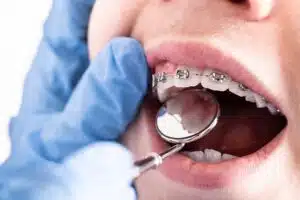
Both systems move teeth in the same way. The bracket is bonded to the tooth, the archwire is tied into the brackets with small elastic ligatures or a built in clip, and the wire’s tendency to return to its shape moves the teeth over time. Adjustments every six to ten weeks change the wire or add elastics. The Cleveland Clinic covers the types of braces in general, and the American Association of Orthodontists explains the mechanics. What you can and cannot eat, how you brush and floss, and how long the whole course takes are all decided by the case and the plan, not by the bracket material.
What is different
|
Metal braces |
Ceramic braces |
|
|---|---|---|
|
Appearance |
Silver brackets, visible |
Tooth colored or clear brackets; wire can be frosted; much less visible |
|
Strength |
Very strong; rarely break |
Brittle; brackets can chip or fracture under a hard bite |
|
Size |
Slightly smaller and lower profile |
Slightly larger to make up for the weaker material |
|
Staining |
Brackets do not stain; colored ties can be chosen |
Brackets do not stain; clear elastic ties can yellow between visits |
|
Friction |
Lower; wire slides easily |
Higher; can slow some movements slightly |
|
Cost |
Usually the least expensive braces option |
Usually higher than metal |
|
Comfort |
Similar |
Similar; ceramic can feel rougher against the lip at first |
|
Best for |
Children, complex cases, lower teeth, patients who want colors |
Teens and adults who want a discreet fixed appliance |
Appearance, honestly
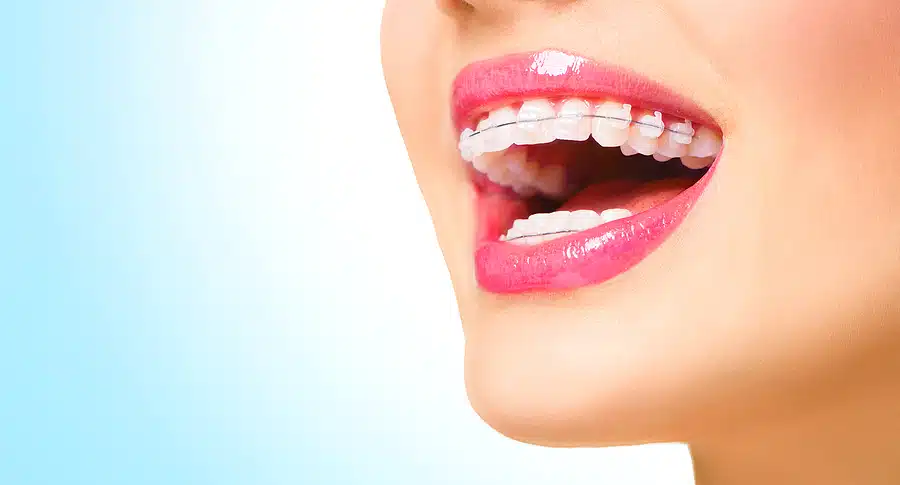
Ceramic braces are not invisible, but from a normal speaking distance they are hard to notice, especially with a frosted or coated wire. Metal braces are visible in every photograph. For many adults in Gallup that difference is the whole decision, and it is a legitimate one; people who would otherwise put off treatment often go ahead because ceramic exists. For children the calculation is usually the reverse: they tend to like choosing the colors of the elastic ties on metal brackets, and the brackets are tougher. The practice’s ceramic braces and braces pages show both, and lingual braces, bonded behind the teeth, are the fully hidden option for patients who want it.
Durability and breakage
Ceramic is a hard but brittle material. A ceramic bracket bonded to a lower tooth that the upper teeth bite against can chip, and a bracket that chips has to be replaced at a visit. This is why many orthodontists put ceramic on the upper teeth and metal on the lower, or use metal on any tooth that takes bite force. Metal brackets almost never break; they come off only when the bond fails, usually because of hard or sticky food. Either way the foods to avoid list from the ADA applies equally.
Staining
A common worry is that ceramic braces turn yellow. The brackets do not; modern ceramic is stain resistant. What can discolor is the small clear elastic tie that holds the wire in each bracket, which picks up color from coffee, tea, curry and red wine over the weeks between visits. The ties are replaced at every adjustment, so the yellowing resets, and patients who are careful about staining foods in the day or two after a visit, when the ties are fresh, notice it least. Self ligating ceramic brackets that clip onto the wire without ties avoid the issue altogether.
Cleaning and daily care
The hygiene routine is identical for both: brush after every meal with a soft brush angled at the gumline and around each bracket, floss nightly with a threader, and rinse. Two small differences are worth knowing. Ceramic brackets are slightly larger, so there is a little more surface for plaque to sit on, and their clear ties show plaque and stain more obviously than colored ties on metal, which some patients find a useful reminder. And because a ceramic bracket is more likely to chip than a metal one, the food rules, no hard candy, ice, popcorn kernels or whole apples, carry a higher cost when ignored. Patients who keep the routine end treatment with the same clean, unmarked enamel regardless of which bracket they chose; the ones with white marks around the brackets on the day of removal are the ones who skipped flossing, not the ones who picked ceramic.
Treatment time and cost
For the same case, treatment time is similar. Ceramic brackets create slightly more friction as the wire slides through them, which can add a few weeks to certain movements, and their brittleness means a broken bracket occasionally delays a step. Neither is a reason to avoid ceramic; both are reasons to follow the food rules. Ceramic braces are usually quoted somewhat higher than metal because the brackets cost more to make and replace, and the practice’s cost of braces page explains what goes into a quote. A written fee for each option is given at the free consultation, and most dental plans with an orthodontic benefit treat the two the same way.
Choosing, by patient
For a child, metal is almost always the right answer: it is tougher, less expensive, and the colors are a feature. See the pediatric orthodontist page. For a teenager, either works; ceramic on the upper front teeth is a popular compromise, and Invisalign Teen is the alternative for a teenager who will wear it, as the teen orthodontist page discusses. For an adult, ceramic or lingual braces are the usual choice when a fixed appliance is needed and appearance matters, with Invisalign as the removable alternative for suitable cases; the AAO’s adult orthodontics page covers why adults are treated at any age. For a complex case, extractions, impacted teeth or a severe bite problem, Dr. Wilson will often recommend metal regardless of age because it is the most controllable appliance, and MedlinePlus explains why those cases need precise control.
OrthoDental Inc.
OrthoDental Inc. is at 1748 W Maloney Ave, Gallup, NM, open Monday to Friday from 8AM to 5PM. Dr. Joseph A. Wilson, DMD, MSD, founded the practice and provides braces, ceramic and lingual braces, Invisalign and retainers for children, teens and adults. Orthodontic consultations are free; call (505) 863-8100 or book online.
Frequently asked questions
Are ceramic braces as effective as metal braces?
Yes, for the same case. They move teeth the same way. Metal is preferred for some complex cases because it is stronger and creates less friction.
Do ceramic braces take longer than metal?
Slightly, in some cases, because of friction and occasional bracket breakage. For most patients the difference is a few weeks at most.
Do ceramic braces stain?
The brackets do not. The clear elastic ties can yellow between visits and are replaced at each adjustment.
Are ceramic braces more expensive?
Usually somewhat, because the brackets cost more. Get a written fee for both at the consultation.
Can I have ceramic on top and metal on the bottom?
Yes, and it is common. Upper front teeth are the visible ones; lower teeth take more bite force and suit metal.
Are ceramic braces more comfortable?
About the same. Ceramic brackets are a little larger and can feel rough against the lip for the first week.
Do ceramic braces break easily?
They are more brittle than metal and can chip under a hard bite, which is why they are placed carefully and food rules matter. Breakage is uncommon with normal care.
Which is better for a child?
Metal. It is tougher, less expensive, and children usually enjoy choosing tie colors.
Are ceramic braces the same as clear aligners?
No. Ceramic braces are fixed brackets that are tooth colored. Clear aligners are removable plastic trays. Both are discreet; they suit different cases and different patients.
Can I switch from metal to ceramic during treatment?
It is possible but rarely worthwhile, since brackets would have to be removed and rebonded. Decide at the start.
—
Metal or ceramic? Book a free consultation with Dr. Joseph A. Wilson at OrthoDental Inc., 1748 W Maloney Ave, Gallup, NM. Call (505) 863-8100 or book now.